HGV defect reporting procedure: step by step
Most fleets already do a daily walkaround check. Where things go wrong is what happens next: the defect gets mentioned in the yard but not written down, nobody with authority sees it, or it gets fixed with no record of the repair. This guide walks through the procedure step by step, using DVSA's own guidance (checked 3 November 2026), so you can write yours down or check the one you have. If you want the check itself, see our DVSA daily walkaround check guide.
What is an HGV defect reporting procedure?
The walkaround check is the look round the vehicle. The defect reporting procedure is everything around it: how a driver writes a defect down, who they tell, who decides whether the truck can go out, how the repair is done and recorded, and where the records are kept. DVSA's guide says there must be a system of reporting and recording defects that may affect roadworthiness, and that it must include how they were put right before the vehicle is used.
It covers three kinds of record:
- Defect reports, when the driver finds something wrong.
- Nil defect reports, when the driver checks and finds nothing. Our nil defect reporting guide explains why these matter.
- Rectification records: what was done to fix each defect, by whom and when.
What DVSA guidance says about defect reporting
These points come from the DVSA Guide to maintaining roadworthiness and the GOV.UK HGV walkaround check guidance:
- The driver is always legally responsible for the condition of the vehicle while it's in use.
- Drivers must report promptly any defects, or symptoms of defects, that could affect the safe operation of the vehicle.
- A walkaround check must be done at least once every day, or once in each 24-hour period the vehicle is used. Arduous or off-road work may need more than one check a day.
- Defects found on the check, while the vehicle is in use or when it gets back to base must be the subject of a written report.
- Defect reports must go to a responsible person with enough authority to take action, which might mean taking the vehicle out of service.
- The system must record how each defect was put right before the vehicle is used. Dangerous defects found on a journey must be fixed before the driver continues.
- Reports listing defects are part of the vehicle's maintenance record and must be kept for at least 15 months, with the assessment, the repair and the repairer.
GOV.UK also notes that you can get an unlimited fine and a prison sentence for using an HGV in a dangerous condition, so the procedure isn't just paperwork.
The defect reporting procedure in 7 steps
Here's the procedure most small fleets can follow. Adapt the names and roles to your own firm, then put it in writing.
Step 1: Do the walkaround check before first use
The driver checks the vehicle before it's first used that day, following the same routine each time so nothing is skipped. GOV.UK lists 27 items for HGVs, from mirrors, glass and wipers in the cab to tyres, brake lines, coupling and load security outside. If a second driver takes the vehicle later the same day, your procedure should say how they check it or see the earlier check. Our free HGV walkaround check template has a checklist you can copy.
Step 2: Write the defect down
A spoken "the nearside light's out" isn't a report. The driver records it in writing, on the defect sheet or in the app, at the time. GOV.UK says to record:
- the vehicle registration or identification mark
- the date
- details of the defects or symptoms
- the driver's assessment of the defect (for example, "dangerous")
- the driver's name
- who it was reported to
A photo of the defect helps whoever fixes it, and helps the person deciding whether the truck can go out. Be specific: which tyre, which light, which side.
Step 3: Assess how serious it is
Someone has to decide whether the defect stops the vehicle being used. The driver gives a first view, and the responsible person or the workshop confirms it. As a rule, anything that affects brakes, steering, tyres, lights, mirrors, coupling or load security is treated as a safety defect until a competent person says otherwise. Write the assessment on the report, because DVSA expects it to be kept with the record.
Step 4: Report it to the responsible person
The report goes to the person named in your procedure, such as the transport manager, a supervisor or the workshop, before the vehicle is used. That person needs the authority to stop the truck going out. Your procedure should also say who to call early in the morning, late at night and at weekends, because defects don't keep office hours.
Step 5: Take it off the road or book it in
If the defect makes the vehicle unsafe, it doesn't go out until it's fixed. Make sure everyone knows that truck is off the road, so nobody takes it by mistake. If it's minor and doesn't affect safety, it can be recorded and booked in for repair, with the decision written down.
Step 6: Repair it and record the repair
The repair is done by someone competent, and the rectification is recorded: what was done, who did it and the date it was completed. If drivers are allowed to fix small things on the road, DVSA's guide says they need the right training and any repair must still go through the defect reporting system.
Step 7: Sign it off and keep the record
Before the vehicle goes back into service, someone confirms the defect is put right and signs the report off. Then keep the full record, defect, assessment, repair and repairer, for at least 15 months. Keep nil defect reports for at least 3 months, as DVSA recommends. More detail in how long to keep walkaround and defect records.
Defects found on the road or on site
Not every defect shows up at the morning check. DVSA's guide says drivers must stay alert to signs of a fault while driving, such as warning lights or vibration, and record and report defects they become aware of during the journey. GOV.UK says to find a safe place to stop, assess the defect and report it.
This matters for tipper work. The guide says that when a vehicle has been on site work, for example on rough ground, the driver must walk round it before leaving the site to look for damage, paying attention to wheels and tyres. If there's a safety defect, the vehicle mustn't go on the road until it's repaired. Quarries, landfill and building sites are exactly where a tyre gets cut or a light gets knocked off, so build this into your procedure.
What to put in your written procedure
DVSA's guide says drivers' responsibilities, including the defect reporting system, should be set out in writing, and each driver should sign to say they've received them and understand what's needed, with a copy kept on file. A one or two page document is enough for a small fleet. Include:
- When the walkaround check is done, and what happens when drivers change during the day.
- Where defects are recorded: which sheet, book or app.
- Who defects are reported to, with names and phone numbers, including out of hours.
- Who can decide that a vehicle is safe to use, and who can take it off the road.
- What drivers do with a defect found on the road or on site.
- Who carries out repairs, including any breakdown cover or outside garage.
- How repairs are recorded and signed off.
- Where records are kept and for how long (15 months for defects and repairs, 3 months recommended for nil reports).
- How drivers are trained, and how you check the procedure is being followed.
If some of your drivers don't have English as a first language, DVSA's guide says operators must make sure extra translation or training is provided. A procedure drivers can't read doesn't protect anyone.
Defect sheets, defect books and apps
DVSA publishes an example driver's vehicle defect report for goods vehicles. It has the driver's name, date, vehicle, trailer and odometer reading, a tick or cross list of items, space for defects, the assessment and rectification, who the defect was reported to, a box to write nil, the driver's signature, and who rectified it with their signature and date. Many firms use a carbon-copy defect book built the same way.
Paper works if it's done properly every day and the books are kept and easy to find. The usual problems are blank days, books left in cabs, and repair details never written on the original sheet.
If you move to an app, DVSA's guide says a system for recording walkaround checks on a phone or tablet must provide a suitable digital signature, secure data input and storage, defects recorded in an accessible format, and confirmation that the vehicle is roadworthy at the start of the journey. It must also have date and time stamps, including on nil reports. For any electronic maintenance system, the guide lists things like tamper-proof records, a clear record of what was checked and by whom, and an end-to-end audit trail. Ask any supplier to show you each of these.
Common gaps in defect reporting
- No nil reports. Records only on days something was wrong look like checks were skipped on the other days.
- Defects told, not written. A phone call to the yard with no written report leaves no record.
- No assessment. The report says what's wrong but not whether the truck was safe to use, or who decided.
- No record of the repair. The defect was fixed, but nothing shows what was done, by whom or when.
- The same defect again and again. A defect reported several times with no repair is worth looking into: the repair may not be working.
- Records you can't find. DVSA can ask for a record of the walkaround check at a roadside check.
The Traffic Commissioners' note on walkaround checks also says operators should keep a full audit trail from finding a defect to repair and re-check, and should spot check reports. Is your maintenance provider finding defects your drivers should have spotted? If so, the walkaround may not be getting done properly.
How Raahi Flow handles defect reporting
Raahi Flow puts the DVSA daily walkaround check on the driver's phone. Each check is signed, and drivers add photos of any defect, which is then followed through to repair and sign-off. When a driver adds a photo of a defect, AI looks at it and gives the manager a short note; the manager still decides whether the truck is roadworthy. A driver can attach their phone's location to the walkaround check.
The app works in six languages: English, Urdu, Polish, Punjabi, Romanian and Lithuanian, so each driver can do the check in their own language. Owners and managers also get reminders in the app for things like MOT, PMI, road tax and insurance. It runs in the phone's browser on Android and iPhone, so there's no app store step.
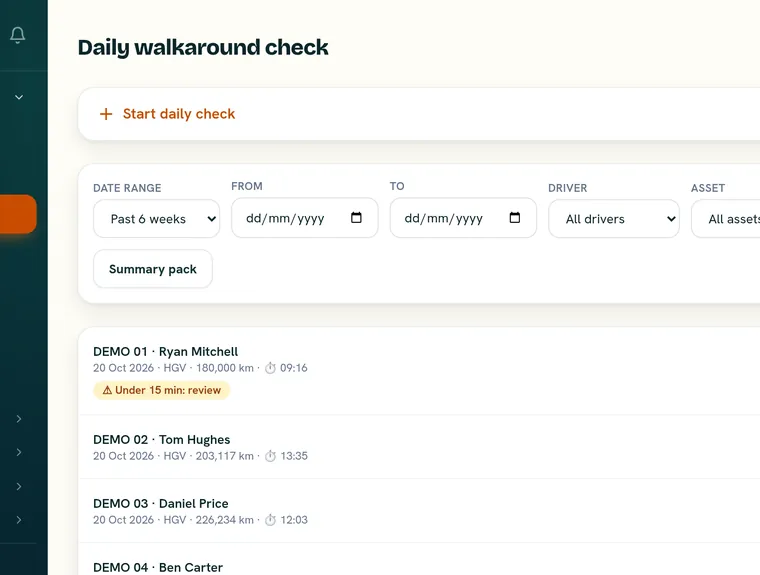
An app doesn't replace your written procedure. You still decide who the responsible person is and who signs vehicles off. See the DVSA walkaround check app for what's in the check.
See the walkaround and defect flow on your own trucks
Book a short demo and we'll walk through a check, a defect and a sign-off. There's a 30-day free trial on up to 3 trucks, no card needed, then £20 per truck per month, no VAT.
Book a demo →Questions about HGV defect reporting
What is the defect reporting procedure for HGV drivers?
The driver does a walkaround check before the vehicle is first used and at least once in every 24 hours it is used. Any defect found on the check, during the journey or back at base is written down and reported to the person in the firm who deals with defects. That person assesses it, and the vehicle isn't used until a safety defect is repaired. The repair is recorded and the report is kept for at least 15 months.
Who should a driver report a defect to?
To the person named in your written procedure as responsible for defects, such as the transport manager, workshop or a supervisor. DVSA's guide says defect reports must go to a responsible person with enough authority to act, which can include taking the vehicle out of service. An owner-driver can simply record the defect and the repair and keep the record for at least 15 months.
Can a driver drive an HGV with a defect?
Not with a defect that makes it unsafe. DVSA's guide says the defect system must show how defects were put right before the vehicle is used, and GOV.UK says dangerous defects found on a journey must be fixed before the driver carries on. A minor defect that doesn't affect safety can be recorded and booked in, but someone competent should make that call and write it down.
What must an HGV defect report include?
DVSA's guide lists the vehicle registration or identification mark, the date, details of the defects or symptoms, the reporter's name, who it was reported to, the assessment of the defect, the rectification work and the date that work was completed. Many operators use a sheet that also lists every item checked, with a box to write nil if nothing was found.
How long must HGV defect reports be kept?
At least 15 months, together with the assessment, the repair and who did it. DVSA recommends keeping nil defect reports, the ones that say nothing was found, for at least 3 months. Electronic records are fine as long as they are available for 15 months with the record of repair.
Is an HGV defect book or app acceptable to DVSA?
Both can be. A paper defect book or sheet works if every check is recorded and the reports are kept and easy to find. DVSA's guide says checks can be done on a phone or tablet if the system gives a digital signature, secure storage, date and time stamps, and confirmation that the vehicle is roadworthy at the start of the journey.
Sources, all checked 3 November 2026: DVSA, Guide to maintaining roadworthiness (updated 28 April 2025), sections on drivers' defect reports and recording walkaround checks; DVSA, Carry out HGV daily walkaround checks (updated 21 September 2023); DVSA, example HGV defect report form (PDF); Traffic Commissioners for Great Britain, The walkaround check: a legal duty and safety priority (September 2025). General information, not legal advice. Check the current DVSA guidance for your own operation.