Haulage rates per mile in the UK: how to work out yours
Every figure on this page comes from GOV.UK, or from the Road Haulage Association's public pages, and was checked on 30 October 2026. We don't quote a "going rate", because we couldn't find an official one and a made-up average would be worse than none. Your own numbers will beat any average.
Why your rate per mile starts with your cost per mile
A customer will tell you what they want to pay. Only you know what a mile costs you. Two tippers on the same job can have very different costs: one is paid off and the other is on finance, one runs back loaded and the other runs back empty, one driver is on a day rate and the other on overtime.
The RHA runs a Cost Movement Survey and a Pay Survey, and publishes cost tables for 2026. It says these are offered as tools for measuring industry costing averages and may help with any negotiation towards haulage rates. They're for members only, so we haven't used their figures here. If you're a member, use them as a cross-check against your own worksheet, not instead of it.
Step 1: Count every mile the truck does
This is the number most hauliers get wrong. Divide your costs by all the miles the truck does in a year, not just the loaded ones. A tipper on aggregate or muck-away work often runs empty back from the tip, between plants or back to the yard. Those miles cost the same fuel and driver time as loaded ones. Our guide to reducing dead mileage in tipper haulage covers how to measure them.
Take the miles from your odometer readings or tachograph records for the last 12 months. If the truck is new to you, use a few weeks of real work and scale it up, then redo the sum once you have a full year.
Two legal limits cap how many miles a truck can earn in a day:
- Drivers' hours. Under the assimilated rules, daily driving is 9 hours, up to 10 hours twice a week, with no more than 56 hours in a week and 90 hours in any 2 weeks. A 45-minute break is due after 4.5 hours of driving.
- Speed. GOV.UK's speed limits for goods vehicles over 7.5 tonnes in England and Wales are 50 mph on single carriageways and 60 mph on dual carriageways and motorways. In Scotland it's 40, 50 and 60 mph. Goods vehicles over 3.5 tonnes must have a speed limiter.
On short tipper runs the limit is usually time on site and in queues, not the road. That's why many tipper jobs are better priced per load or per day than per mile (see step 6).
Step 2: Add up your fixed costs for the year
Fixed costs are the ones you pay whether the truck turns a wheel or not. List them for one truck, for a full year. Use your own invoices and bank statements.
| Fixed cost (per truck, per year) | Where to find it | Your figure (£) |
|---|---|---|
| Finance, lease or the truck's loss in value | Finance agreement or your accountant | |
| Insurance | Your policy schedule | |
| VED and HGV levy | GOV.UK V149/1 (see the table below) | |
| O-licence continuation fee | £401 every 5 years, so a fifth of that a year, spread across your trucks | |
| Safety inspections, MOT and service contract | Your maintenance provider's invoices | |
| Tachograph calibration | Your calibration centre's invoice | |
| Yard or operating centre | Rent, rates and power, split per truck | |
| Office, phones, software, accountant | Your overheads, split per truck | |
| B. Total fixed costs | Add the lines above |
Then fixed cost per mile = B ÷ A, where A is the yearly miles from step 1.
VED and the HGV levy are paid together for UK lorries. These are GOV.UK's V149/1 rates from 1 July 2026 for a rigid lorry without a trailer, for 12 months:
| Rigid lorry (revenue weight) | VED band | VED | HGV levy, Euro VI or later | HGV levy, Euro V or earlier |
|---|---|---|---|---|
| 3 axles, over 25,000 kg and not over 27,000 kg (a 26-tonne 6-wheeler) | D1 | £1 | £161 | £209 |
| 4 axles, over 27,000 kg and not over 44,000 kg (a 32-tonne 8-wheeler) | E1 | £1 | £387 | £503 |
Check your own truck's band in the V149/1 tables, because it depends on the revenue weight, axles and Euro status.
Step 3: Work out your running costs per mile
Running costs go up with every mile. Work each one out per mile.
- Fuel. Fuel cost per mile = price per litre × 4.54609 ÷ miles per gallon. Use the price on your fuel card and the miles per gallon from your own fuel and mileage records, not the maker's figure. If you're VAT registered and the lorry is only used for business, GOV.UK says you can usually reclaim all the VAT on its fuel, so use the price without VAT.
- AdBlue. Litres bought in a year × price per litre ÷ miles in the year.
- Tyres. Cost of a set ÷ the miles a set lasts on your work. Tipper tyres on sites and haul roads often wear faster than on motorway work, so use your own history.
- Repairs not covered by a contract. Last year's repair bills ÷ last year's miles.
To check your fuel price against the market, use GOV.UK's weekly road fuel prices. They're average UK pump prices, so a fuel card or bunkered price may be different. In the week of 26 October 2026 diesel averaged 199.22p a litre, including 52.95p of duty and 20% VAT. Without the VAT that's about 166.02p a litre, or about £7.55 a UK gallon. A year earlier, in the week of 27 October 2025, it was 142.38p a litre. That's a rise of 56.84p a litre, about 40%, so a rate worked out on last year's fuel won't cover this year's.
| Running cost | How to work it out | Your figure (pence per mile) |
|---|---|---|
| Fuel | Price per litre × 4.54609 ÷ your mpg | |
| AdBlue | Yearly AdBlue spend ÷ yearly miles | |
| Tyres | Cost of a set ÷ miles a set lasts | |
| Repairs | Yearly repair bills ÷ yearly miles | |
| C. Running cost per mile | Add the lines above |
Step 4: Add the driver's cost per mile
Add up what the driver costs you in a year: pay, overtime, nights out, employer National Insurance, pension and holiday pay. Divide by the truck's yearly miles. That's D, driver cost per mile. If you drive the truck yourself, put in what you'd have to pay someone else, or your rate will hide the fact that you're working for less.
The legal floor moves every year. GOV.UK's National Living Wage for workers aged 21 and over is £12.71 an hour from April 2026 and £13.21 from April 2027. Most HGV drivers are paid well above it, but every change on 1 April is a reason to rerun the sum.
A word on paying drivers by the mile. GOV.UK says operators must not make payments to drivers related to distances travelled, speed of delivery or the amount of goods carried if that would encourage breaches of the drivers' hours rules. Working out your cost per mile is fine. Tying the driver's pay to miles needs care.
Step 5: Your cost per mile, then your rate
| Line | Sum | Your figure |
|---|---|---|
| A. Miles a year, laden and empty | From step 1 | |
| Fixed cost per mile | B ÷ A | |
| C. Running cost per mile | From step 3 | |
| D. Driver cost per mile | From step 4 | |
| E. Cost per mile | (B ÷ A) + C + D | |
| Rate per mile | E plus your margin |
Your margin is your call. It has to cover the weeks a truck is off the road, slow payers and the money you need to replace the truck. It isn't something we can give you a number for.
One more cost to keep in mind is waiting to be paid. GOV.UK says the statutory interest you can charge another business for a late payment is 8% plus the Bank of England base rate, unless your contract sets a different rate. Put your payment terms in writing when you agree the rate.
Step 6: Turn it into a rate per load, per tonne or per day
Most tipper customers don't pay per mile. Aggregate and tarmac work is often paid per tonne or per load, muck-away per load, and some work by the day or hour. Your cost per mile still sits underneath every one of them:
- Per load: (miles to site + miles back, even if empty) × E, plus the time on site and in the queue at your cost per hour, plus margin.
- Per tonne: your rate per load ÷ the tonnes you can legally carry. The weighbridge ticket is the number that counts. See what to check on a weighbridge ticket.
- Per day or per hour: your yearly fixed and driver costs ÷ your working days (or hours), plus the running cost per mile × the miles you expect in a day.
Some costs sit outside the per-mile rate and should be agreed as extras before the work starts: waiting time beyond the free allowance, return loads, extra miles when a driver is diverted, and cancelled or aborted jobs. Our guides to waiting time, return loads and extra miles and abortive and cancelled job charges show how each one is usually charged.
Step 7: Check the rate actually gets paid
A good rate is no use if loads drop off the invoice. Tipper work is billed from tickets, one per load, and many aggregate and tarmac customers send a weekly self-bill. Check every ticket against every invoice line each week, so a load that isn't on the invoice yet gets raised while it's fresh. Read self-billing for hauliers for what to look for.
Where Raahi Flow fits
Raahi Flow won't set your rates for you, and this page isn't financial advice. What it does is keep some of the numbers behind the worksheet in one place. Drivers log each fill on their phone with a receipt photo. Set your weekly diesel price and every fill is costed for you and added to that truck's costs. See fuel spend, litres and MPG for each truck, and income, costs and profit per truck. You can set day, night, artic or monthly rates and the app works out each driver's pay, with premiums and dead miles logged as they work. The cost per mile itself is yours to work out with the worksheet above.
On the money side, drivers snap each delivery or weighbridge ticket and the app reads it, then matches it by ticket number to the invoice line for that load, with waiting time and return loads compared too. Raahi Flow matched £8,745 of tickets to invoices on one truck.
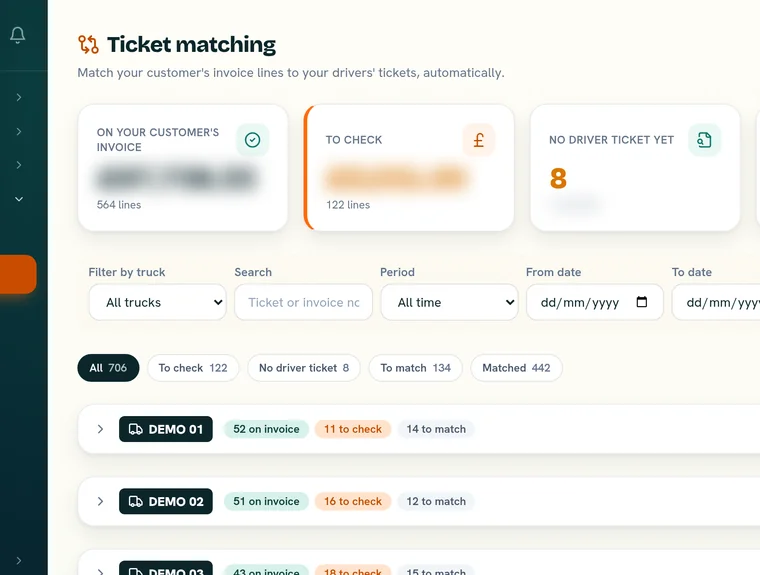
See how it works for invoices on our haulage invoicing software page and our ticket to invoice matching page, read about tipper lorry software, or check Raahi Flow pricing: a 30-day free trial on up to 3 trucks with no card needed, then £20 per truck per month, no VAT.
Want to see your per-truck numbers in one place?
Book a short demo and we'll show you driver pay, per-truck income and costs and ticket matching for a small tipper fleet.
Book a demo →Questions about haulage rates per mile
What is the average haulage rate per mile in the UK?
There's no official UK rate per mile. Rates are agreed between you and each customer, and they depend on your own costs. The RHA publishes a Cost Movement Survey report, a Pay Survey and cost tables for its members, which it says may help with negotiating haulage rates. The safest starting point is your own cost per mile, because fuel, finance, wages and empty running differ from firm to firm.
How do I work out my cost per mile for a lorry?
Add up the truck's fixed costs for a year (finance, insurance, VED and HGV levy, maintenance, yard and overheads) and divide by every mile it does in that year, laden and empty. Then add the running costs per mile (fuel, AdBlue, tyres and repairs) and the driver's cost per mile. That total is your cost per mile. Your rate is that figure plus your margin.
How do I work out fuel cost per mile for a lorry?
Take the price you pay per litre, multiply by 4.54609 (litres in a UK gallon) and divide by the truck's miles per gallon from your own fuel and mileage records. If you're VAT registered and the lorry is only used for business, GOV.UK says you can usually reclaim all the VAT on its fuel, so use the price without VAT. GOV.UK's average UK pump price for diesel in the week of 26 October 2026 was 199.22p a litre including VAT.
Should empty miles be included in my haulage rate?
Yes. A tipper that runs back empty after every tip still burns fuel, tyres and driver hours on the way back. If you divide your costs by laden miles only, or price a job on the loaded leg alone, the rate won't cover the truck. Count every mile in your cost per mile, then price each job on the full round trip.
Can I pay my drivers by the mile?
Be careful. GOV.UK's drivers' hours guidance says operators must not make payments to drivers related to distances travelled, speed of delivery or the amount carried if that would encourage breaking the rules. Many firms pay by the hour, the day or a set rate instead. Get advice before you tie pay to miles.
How often should I update my haulage rates?
Whenever a big cost moves. GOV.UK publishes UK pump prices every week, and diesel went from 142.38p a litre in the week of 27 October 2025 to 199.22p in the week of 26 October 2026. VED and HGV levy rates are set in GOV.UK's V149/1 tables, the latest from 1 July 2026, and the National Living Wage changes every 1 April. Rerun the worksheet at least then, and before you price a new contract.
Sources, all checked 30 October 2026: GOV.UK (Department for Energy Security and Net Zero), Weekly road fuel prices (week commencing 26 October 2026, and 27 October 2025 for the year-on-year change); GOV.UK, Rates of vehicle tax V149/1 (rates from 1 July 2026); GOV.UK, Fees for goods vehicle licences; GOV.UK, Drivers' hours: assimilated and AETR rules and responsibilities of vehicle operators; GOV.UK, Speed limits; GOV.UK, Reclaim VAT on business expenses; GOV.UK, National Minimum Wage and National Living Wage rates; GOV.UK, Late commercial payments: charging interest; Road Haulage Association, Annual Cost Movement and Pay Surveys. Prices and rates change, so check the sources before you price a job. This guide is general information, not financial or legal advice.