How to start a tipper truck business in the UK, step by step
This guide follows the order most new tipper firms actually go through it. Every figure comes from GOV.UK and was checked on 29 October 2026. The rules below are for Great Britain. Northern Ireland has its own system.
Step 1: Decide what work you'll do and pick the licence
GOV.UK says you need a goods vehicle operator licence to carry goods in a vehicle with a gross plated weight over 3,500 kg. A 6-wheel or 8-wheel tipper is well over that, so the question isn't whether you need a licence but which one. (A small tipper at or under 3,500 kg gross plated weight doesn't need one for work in Great Britain, but this guide is about HGV tippers.) There are 3 types:
| Licence | What it lets you carry | Fits |
|---|---|---|
| Restricted | Your own goods only, never other people's | A builder or groundworker moving their own materials |
| Standard national | Your own goods, and other people's goods in the UK | Most tipper hauliers paid to move aggregate, spoil or tarmac for others |
| Standard international | Your own and other people's goods, in the UK and abroad | Firms that will also work outside the UK |
If anyone pays you to move their materials, a restricted licence won't cover it. Our guide to standard vs restricted operator licences goes through the grey areas.
Step 2: Set up the business before you apply
Choose whether you'll trade as a sole trader, a partnership or a limited company. GOV.UK's set up a business guide explains each one. Decide this first, for two reasons:
- The money has to be in the applicant's name. GOV.UK's financial evidence page says documents must be in the same name as the person or company applying, and a limited company's details must match Companies House.
- Changing later means telling the Traffic Commissioner. The goods vehicle operator licensing guide says you must report a change from sole trader or partnership to a limited company within 28 days, and some changes need a new licence.
Keep an eye on VAT too. GOV.UK says you must register for VAT if your taxable turnover goes over £90,000 in 12 months, and you can choose to register below that.
Step 3: Show the money (financial standing)
The Traffic Commissioner wants proof that you can keep your lorries safe and legal. GOV.UK sets the amounts for heavy goods vehicles:
| Licence | First lorry | Each extra lorry |
|---|---|---|
| Standard national or international | £8,000 | £4,500 |
| Restricted | £3,100 | £1,700 |
So on a standard licence, 1 lorry means showing £8,000, 2 lorries £12,500 and 3 lorries £17,000. Apply for the number you plan to run: GOV.UK says that if you plan to grow, you must prove you have the money for all the vehicles you plan to operate, not just the first ones.
This is not a fee. The licensing guide says it's money that must stay available for as long as you hold the licence. Evidence can include bank statements covering the last 28 days, an agreed overdraft or credit facility, invoice finance agreements or audited accounts.
Step 4: Name a transport manager
A standard licence needs a transport manager who holds the Transport Manager Certificate of Professional Competence (CPC) and is approved by the Traffic Commissioner. They make sure drivers hold valid licences, lorries are taxed, insured, tested and maintained, loads are safe and drivers keep to the hours rules. They don't need a driving licence themselves.
You have two options:
- Do it yourself. The licensing guide says the transport manager can be the operator, if qualified. Many owner-drivers take the CPC for this reason.
- Contract an external transport manager. They can work for up to 4 operators with a combined fleet of no more than 50 vehicles, and need a written contract with you.
Either way, the role is real, day-to-day work. See transport manager duties in a small tipper fleet.
Step 5: Find an operating centre and advertise it
Your operating centre is where the lorries are normally kept when not in use. GOV.UK says you must show it's large enough, has safe access and is in an environmentally acceptable location, and if you don't own it, that you're allowed to use it.
You must advertise your application in a local newspaper at least once in the period from 21 days before to 21 days after you apply. Local councils, planning authorities and others can object, including on the environmental impact of the site. Tipper yards draw attention: early starts, reversing alarms and mud on the road. Pick a site with room to turn and park every lorry you'll put on the licence. Our operator licence basics for tipper operators covers the promises that come with it.
Step 6: Arrange safety inspections before you apply
GOV.UK's maintaining your vehicles page says you must keep lorries safe at all times and keep inspection and maintenance records for at least 15 months. If you don't do the work yourself, you must give the Traffic Commissioner a copy of a contract with a maintenance provider. You're still responsible for the lorry's condition either way.
Plan two things now:
- A safety inspection interval. Tippers work hard, so set an interval you'll actually keep. See PMI inspection intervals for tippers.
- A daily walkaround check. Drivers must check the lorry before driving it for the first time each day, and record what they find. Our DVSA daily walkaround check guide lists every item.
Step 7: Apply and pay the fees
You can apply for a vehicle operator licence online. The fees for goods vehicle licences are:
| Fee | Amount |
|---|---|
| Application for a licence | £257 |
| Issue of a licence | £401 |
| Interim licence (if you need one) | £68 |
| Continuation every 5 years | £401 |
That's £658 to get a standard licence in the first place, or £726 with an interim licence. GOV.UK says you'll usually get a decision within 7 weeks, and it takes longer if documents are missing. It's illegal to operate before the licence is issued. If you have customers waiting, an interim licence can let you work for up to 6 months while the full application is looked at, once the full application is in.
Step 8: Drivers, tachographs and insurance
Drivers. You must check that anyone who drives for you holds the right licence and training. To drive an HGV professionally a driver needs a full car licence, the HGV licence for the lorry and the Driver CPC. Driver CPC needs 35 hours of training every 5 years, and GOV.UK says driving professionally without it can mean a fine of up to £1,000. Track every expiry date from day one. See driver licence, CPC and tacho card expiry.
Tachographs. As the operator you must download driver cards at least every 28 days and each vehicle unit at least every 90 days, and you'll need a company card to download the vehicle unit. Our guide to tachograph download rules has the detail.
Insurance. GOV.UK says you must have motor insurance to drive on UK roads, and third party is the legal minimum. Ask a broker what else your customers will want to see before they give you work.
Waste. If you'll do muck-away or carry other people's spoil, you'll probably need to register as a waste carrier. In England that's with the Environment Agency, and GOV.UK says it costs £191.02 unless you only carry waste you produce yourself. Upper tier registrations are renewed every 3 years for £130.25. Wales and Scotland have their own process. Not sure which lorry suits which job? See muck away vs grab lorry vs tipper.
Step 9: Find work and get paid for every load
Most new tipper firms start by subcontracting: hauling aggregate or tarmac for quarries and plants, or muck-away for groundworkers and builders. A few things decide whether that work pays:
- Keep every ticket. The delivery or weighbridge ticket is your proof of the load. Know what to check on a weighbridge ticket before your first job.
- Agree the extras up front. Waiting time and return loads only get paid if they're agreed and recorded. See waiting time, return loads and extra miles.
- Understand self-billing. Many aggregate and tarmac customers raise the invoice for you. Read self-billing for hauliers so you know what to check each week.
Start-up checklist
| Step | Done when |
|---|---|
| Business set up | Sole trader, partnership or company chosen and registered |
| Money in place | £8,000 for the first lorry, £4,500 for each extra, in the applicant's name |
| Transport manager | You hold the CPC, or an external transport manager is under contract |
| Operating centre | Site agreed, room for every lorry, advert placed in a local newspaper |
| Maintenance | Inspection interval set, contract signed if you don't do it yourself |
| Licence | Applied online, £257 paid, then £401 on issue |
| Drivers | HGV licence and Driver CPC checked, expiry dates recorded |
| Tachographs | Company card ordered, download dates set for cards and vehicle units |
| Insurance and waste | Motor insurance in place, waste carrier registration if needed |
Where Raahi Flow fits once you're running
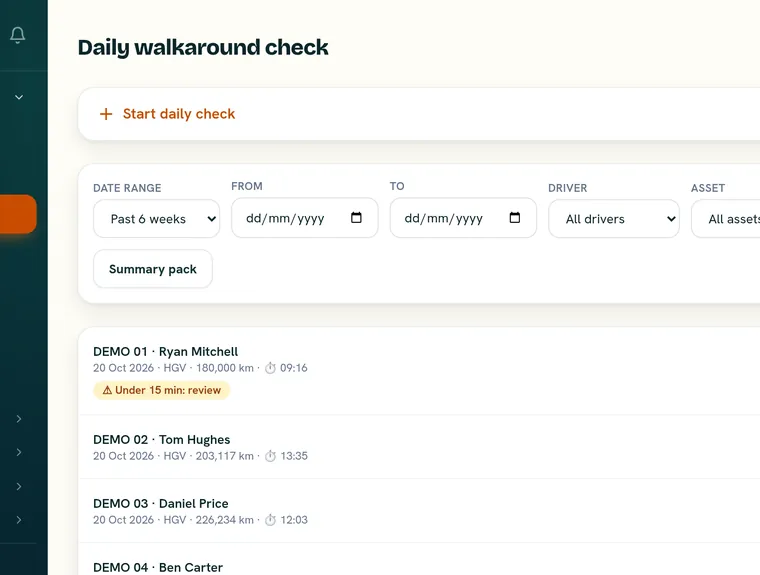
Raahi Flow doesn't apply for your licence and isn't legal advice. It helps with the day-to-day side once the lorries are working. Drivers do the DVSA daily walkaround check on their phone, signed and with photos, and each defect is followed through to repair and sign-off. You get reminders for MOT, PMI, road tax, insurance and tacho calibration, for driving licences, Driver CPC, driver cards and tacho cards, and for your O-licence.
On the money side, drivers snap each delivery or weighbridge ticket and the app reads it, then matches it by ticket number to the invoice line for that load, with waiting time and return loads compared too. You can create invoices and see income and costs per truck. Raahi Flow matched £8,745 of tickets to invoices on one truck.
Starting with one lorry? Read tipper software for owner-drivers, see our tipper lorry software and O-licence compliance software, or check Raahi Flow pricing: a 30-day free trial on up to 3 trucks with no card needed, then £20 per truck per month, no VAT.
Starting out with one or two lorries?
Book a short demo and we'll show you walkarounds, reminders and ticket matching for a small fleet.
Book a demo →Questions about starting a tipper business
Do I need an operator licence to start a tipper business?
Yes. GOV.UK says you need a goods vehicle operator licence to carry goods in a vehicle with a gross plated weight over 3,500 kg, and a 6-wheel or 8-wheel tipper is well over that. If you'll be paid to carry other firms' materials, you need a standard national licence. A restricted licence only covers your own goods.
How much money do I need to start a tipper business in the UK?
For a standard licence you must show £8,000 available for the first lorry and £4,500 for each extra one. That money isn't a fee, it has to stay available for as long as you hold the licence. On top of that the licence fees are £257 to apply and £401 when it's issued. The truck, insurance, fuel and wages are extra and depend on your own deal.
Can I be my own transport manager?
Yes, if you hold the Transport Manager CPC. GOV.UK's licensing guide says the transport manager can be the operator if qualified. If you don't hold it, you can contract an external transport manager, who can work for up to 4 operators with 50 vehicles in total.
How long does it take to get an O-licence?
GOV.UK says you'll usually get a decision within 7 weeks, and it takes longer if documents are missing. It's illegal to operate before the licence is issued. If you already have work waiting, you can ask for an interim licence, which costs £68 and lasts up to 6 months, once your full application is in.
Do I need a waste carrier licence for muck-away work?
If your business transports waste, yes. In England you register with the Environment Agency, and GOV.UK says it costs £191.02 unless you only carry waste you produce yourself. Upper tier registrations are renewed every 3 years. Wales and Scotland have their own registration.
Can I start with one tipper as an owner-driver?
Yes. There's no minimum fleet size. You still need the O-licence, £8,000 of financial standing for one lorry on a standard licence, a transport manager (you, if you hold the CPC), an operating centre, a maintenance arrangement and your own HGV licence with Driver CPC.
Sources, all GOV.UK and all checked 29 October 2026: Being a goods vehicle operator (overview, types of licence, fees, operating centres, maintaining your vehicles); Apply for a vehicle operator licence and its financial evidence page; DVSA and the Traffic Commissioners, Goods vehicle operator licensing guide; Become a transport manager; Become a qualified HGV or bus driver; Driver CPC training; Drivers' hours and tachographs: responsibilities of vehicle operators; Vehicle insurance; Register as a waste carrier (England); Register for VAT; Set up a business. Fees and amounts change, so check GOV.UK before you apply. This guide is general information, not legal or financial advice.